


Belgium
From 8 to 14 December 2025
The fourth week marks the final stage of the Tracked & Trusted European HVO Tour. This week is deliberately shorter in terms of distance, but particularly representative of the real operating conditions encountered on the major transport networks of Western and Northern Europe.
The two Stellantis vehicles equipped with the H3TECH system, developed by SP3H with Electromaintenance, travelled successively through Denmark, Germany, the Netherlands and Belgium, before converging on France to conclude the tour in Carrières-sous-Poissy, the initial starting point of the project.
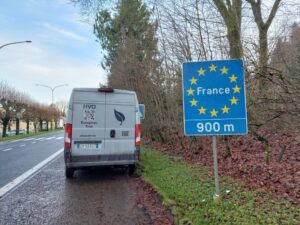
Back to France
Two complementary uses, one demonstration objective
During this last week, the Citroën Berlingo drove continuously in France, alternating between interurban routes, suburban crossings and motorway sections.
The Fiat Ducato, meanwhile, continued its return journey along major European logistics routes, with long motorway stretches before heading back south.
This complementarity in terms of size, engine type and use makes it possible to document a spectrum that is particularly representative of the actual operating conditions of light commercial vehicles across Europe.
Key figures:
In the single week:
- Just over 3,000 km travelled
- Approximately 49 hours of cumulative actual driving time
- ~3,500 consolidated telemetry records
- Approximately 24,500 usable field data points (distance, geolocation, fuel temperature, %HVO, CO₂ factor)
Each record corresponds to a time-stamped and geolocated point, certifying the actual fuel consumption at the precise moment of driving.
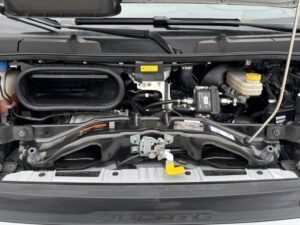
Behind the visible data: continuous molecular measurement
As in the first three weeks, the consolidated data is based on a much denser measurement grid.
Each saved point is the result of a continuous internal calculation based on the acquisition of approximately 40 successive spectral signatures, taken at an average frequency of one measurement every 6 seconds.
Over the entire fourth week, this process generated more than 1.2 million individual spectral signatures, constituting certifying measurements in the physical sense of the term.
These signatures are continuously analysed by FluidBOX® / H3TECH® sensors, then aggregated and transmitted to supervision and reporting systems.
CO₂ impact: A measurable reduction right down to the last kilometre
Over an equivalent distance travelled using B7 diesel, emissions would have amounted to approximately 600 to 650 kg of CO₂.
Thanks to the use of HVO, which has an emission factor reduced by approximately 83% compared to fossil diesel, emissions associated with the same journey are around 100 to 120 kg of CO₂.
👉 Result: nearly 500 kg of CO₂ avoided in the fourth week.
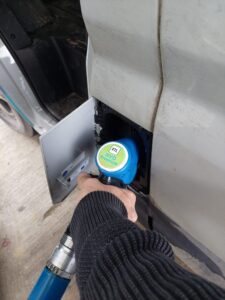
France Pontault
Closing of the Tour: a comprehensive, measured and verifiable demonstration
With this fourth week, the Tracked & Trusted European HVO Tour comes to an end after more than a month of continuous driving across Europe.
From the southern Mediterranean to the northern logistics corridors, from secondary roads to European motorways, the demonstration is now complete:
- On-board traceability works in real-world conditions,
- renewable fuels enable a massive and measurable reduction in emissions,
- and the decarbonisation of existing combustion engine vehicles is already operational today, without any modifications to engines or infrastructure.
The Tour may be over, but the data remains: auditable, usable and ready to fuel tomorrow’s CO₂ strategies.
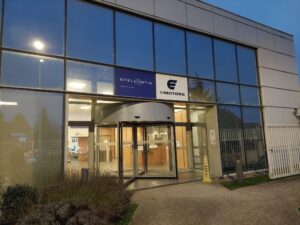
Return of vehicles to Stellantis, Carrières-sous-Poissy

