


Belgium
From 1 to 7 December 2025
73 hours of driving, 6,000 km, Mediterranean → Atlantic → Scandinavia
The third week of the Tracked & Trusted European HVO Tour once again confirms the robustness of the H3TECH on-board system and the wide variety of situations encountered on European roads.
Two vehicles, two routes, two climates… but one certainty: fuel traceability works everywhere, whatever the conditions.

Spain
Berlingo: A southern loop between France, Spain and Portugal (≈ 3,000 km)
The Citroën Berlingo travelled along the southern coast of Europe.
Its route took it to:
-
from France to Catalonia, then Zaragoza and Madrid,
-
to Galicia, with a visit to the Stellantis site in Vigo where this model is assembled,
-
then to Porto and Braga in Portugal,
-
before travelling up the northern Spanish coast, via Bilbao and San Sebastián,
-
and a return journey via south-western France.
The week was marked by a notable contrast in weather conditions:
– Mild temperatures in Catalonia and Portugal,
– Unexpected snowfall between Madrid and Vigo, demonstrating the stability of fuel measurements despite significant temperature variations.
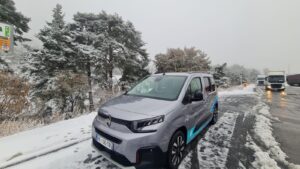
Madrid
Ducato: The far north to Copenhagen (≈ 3,000 km)
The Fiat Ducato continued its journey through northern Europe.
From Finland, it travelled along the Gulf of Bothnia to:
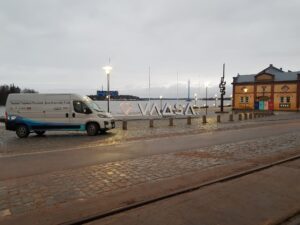
Finland
-
Oulu, then northern Sweden (Luleå, Umeå),
-
Sundsvall and Uppsala,
-
bypassed Stockholm,
-
joins Gothenburg,
-
before crossing the Øresund to end the week in Copenhagen, Denmark.
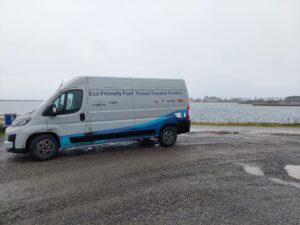
Danemark
The conditions were typically Scandinavian:
➡️ temperatures between 2 and 3 °C,
➡️ periods of frost, cold rain, and snowfall.
Despite this, the measurement chain remained perfectly stable, with continuous traceability of fuel in real driving conditions.
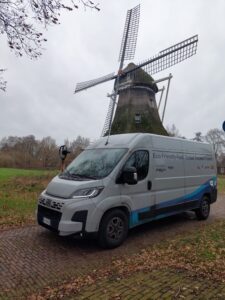
Germany
A data-rich week: 5,400 records & 1.7 million molecular signatures
The combined activity of the two vehicles generated:
-
5,400 telemetry records usable via H3TECH,
-
Over 1.7 million NIR spectral signatures from FluidBOX® onboard sensors,
ensuring accurate and continuous monitoring of fuel behaviour throughout the entire journey.
This data covers a wide variety of situations:
temperature variations, altitudes, driving styles, road types, heavy urban traffic, Spanish motorways, wet Atlantic coasts, and Scandinavian winter weather.
The density and quality of the data confirm the ability of the onboard system to operate without interruption, from the tank to the wheel.
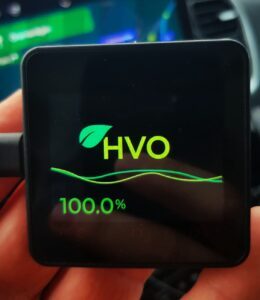
100% HVO in Sweden
CO₂ impact: –860 kg in week 3 alone
On an equivalent journey using B7 fuel, emissions would be just over one tonne of CO₂.
With HVO (–83% CO₂):
-
emissions over the week ≈ 180 kg,
-
That is 860 kg of CO₂ avoided for this week alone (WK3).
A measurable, verifiable impact that complies with European regulatory requirements (CSRD, RED III, CAFE).
Conclusion: Mediterranean, Atlantic, Baltic: the same demonstration
In three weeks:
-
The European HVO network already enables seamless driving from the south to the north of the continent.
-
On-board traceability works in all conditions, without exception.
-
HVO renewable fuels enable massive CO₂ reductions, measured under real-world conditions.
-
The database generated is one of the most comprehensive ever collected on the road concerning non-fossil fuels.
Week 3 reinforces an obvious fact:
– Decarbonising existing combustion engine vehicles is an operational reality, not a promise.
– And thanks to on-board certification, this reality becomes measurable, transparent and universally verifiable.

Zaragoza, Spain

